FA-RDP: A Frequency-Adaptive Reactive Diffusion Policy
for Contact-Rich Manipulation

Lifeng Zhuo*1   Wendi Chen*1,2   Han Xue1   Shirun Tang3   Jun Lv3   Cewu Lu1,2,3†   Chuan Wen1†

1Shanghai Jiao Tong University    2Shanghai Innovation Institute    3Noematrix Ltd.

* Equal contribution  ·  † Corresponding authors  ·  Lifeng Zhuo and Wendi Chen contributed equally to this work.

Summary

Abstract

In contact-rich manipulation, action multimodality and reactivity dominate different stages of a single episode. Before contact, multiple trajectories might be equally valid, making it important to preserve diverse action modes. After contact, geometric constraints and force limits narrow the solution space, while successful execution demands rapid responses to force feedback. However, standard diffusion policies use a fixed inference frequency and sampling steps throughout the episode, forcing a fundamental compromise: low-frequency, multi-step sampling better preserves pre-contact multimodality but responds slowly to force feedback, whereas high-frequency sampling improves reactivity but tends to collapse distinct pre-contact modes. To resolve this tradeoff, we present FA-RDP, a frequency-adaptive reactive diffusion policy. A shared multi-frequency visual-force Transformer predicts action chunks at both low and high frequencies, while a learned multimodality indicator dynamically selects multi-step low-frequency sampling before contact and one-step high-frequency sampling as action ambiguity decreases. We further introduce Manifold Consistency Distillation (MCD), which reparameterizes the diffusion network to predict actions on the robot action manifold while retaining DDPM-based residual supervision. Experiments on three contact-rich manipulation tasks show that FA-RDP achieves the highest success rate while preserving diverse pre-contact trajectory modes. Code will be made publicly available.

Motivation

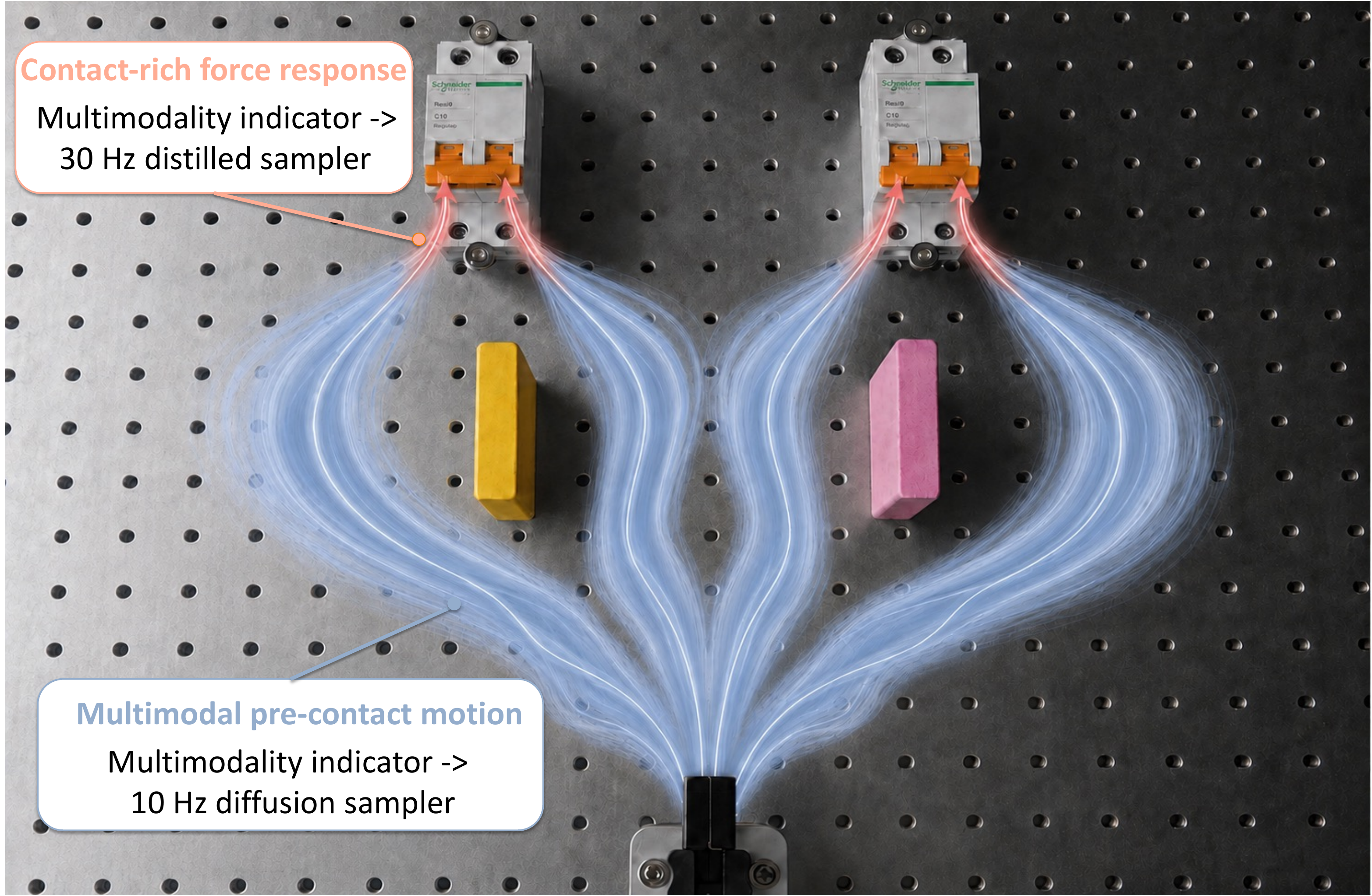
A contact-rich task changes character mid-episode, and each existing family of policies handles only one half well:

Motivation

FA-RDP keeps one end-to-end model and adapts its frequency: a 10 Hz diffusion sampler before contact preserves the multiple valid approach modes, and a 30 Hz distilled sampler after contact reacts quickly to force.

Method

FA-RDP addresses the low force-feedback frequency of prior end-to-end policies with a multi-frequency visual-force diffusion backbone. It preserves multimodal pre-contact behavior while enabling high-frequency control through three components.

1 · Multi-Frequency Visual-Force Transformer

FA-RDP realizes frequency-adaptive visual-force control through a shared multi-frequency visual-force Transformer. The same backbone is used for both frequency modes: a single forward pass is conditioned on one frequency mode $\nu \in \{\ell, h\}$ and predicts the action chunk for that mode.

The key design is a frequency-adaptive positional encoding. The frequency mode is not embedded as an extra token; instead, it selects temporal indices on a shared temporal grid. The high-frequency mode uses consecutive positions, whereas the low-frequency mode uses sparse positions, so both modes are expressed on the same underlying clock. We use a causal action-force mask to avoid future-contact leakage.
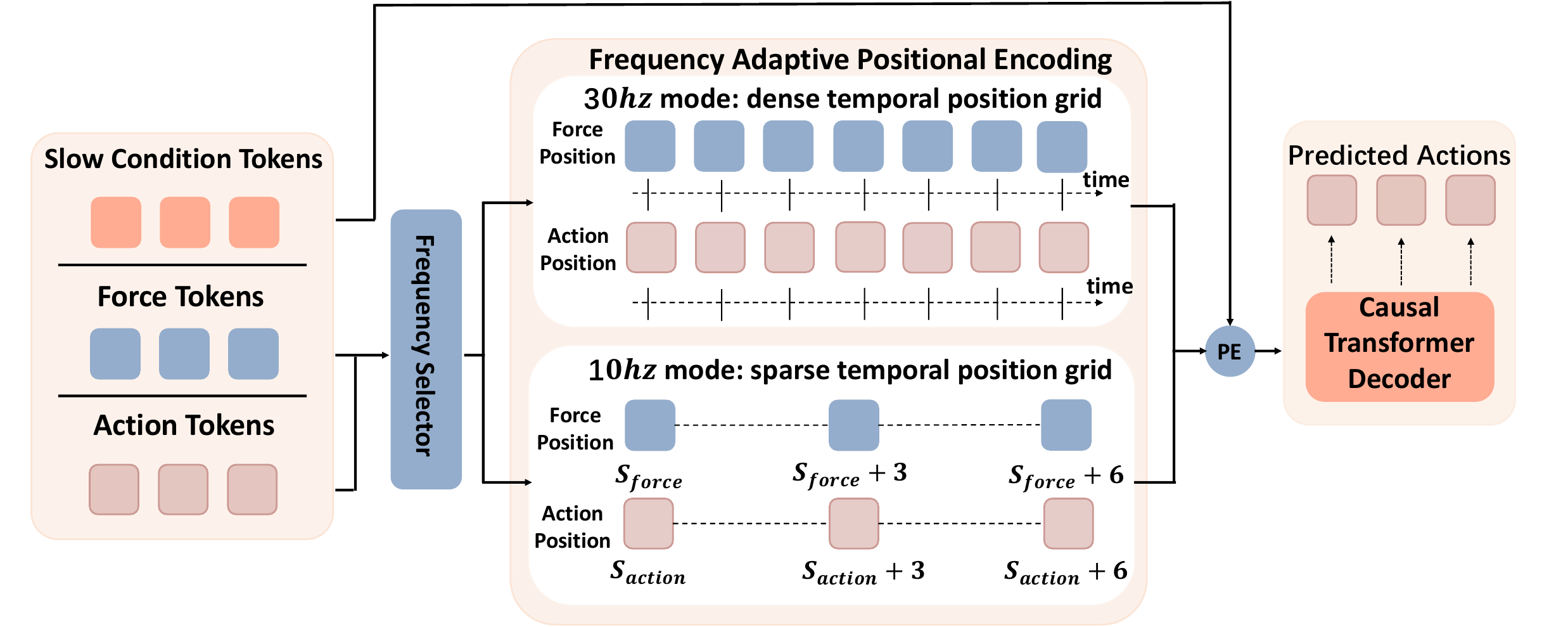
Multi-Frequency Transformer

Dense positions for high-frequency chunks, sparse positions for low-frequency chunks, on one shared temporal grid.

2 · Multimodality-Based Frequency Selection

The multi-frequency Transformer provides both low-frequency and high-frequency diffusion samplers, but the policy still needs to decide which sampler to use at different phases. We use a learned indicator that estimates local multimodality instead of relying on a phase label.

At inference time, FA-RDP computes the indicator value from the current slow tokens and selects the sampler with a fixed threshold. This makes execution frequency-adaptive, but the selected high-frequency diffusion sampler still requires multi-step denoising. We therefore distill the high-frequency sampler for fast force-feedback response.

3 · Manifold Consistency Distillation (MCD)

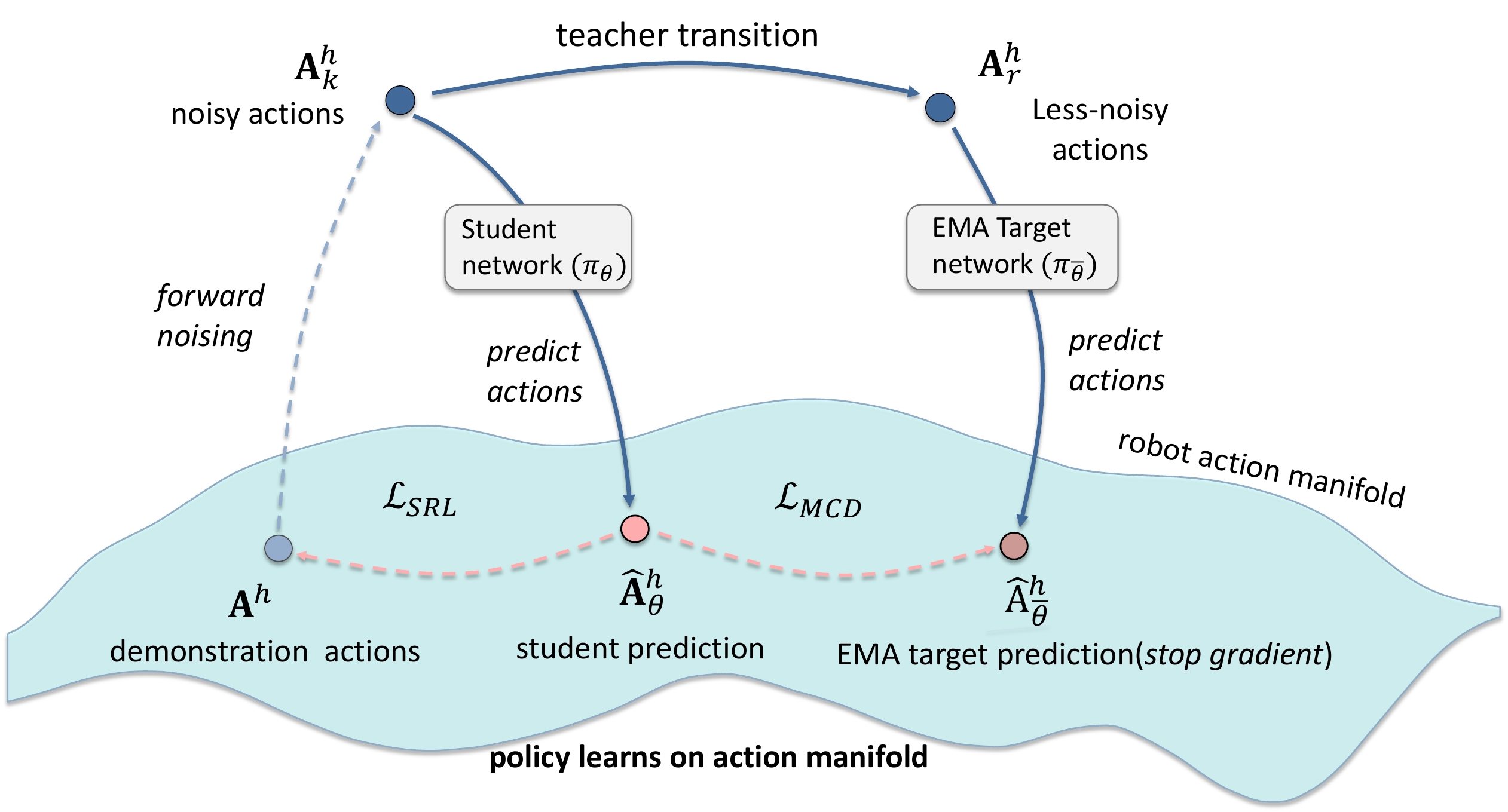
Manifold consistency distillation (MCD) turns the selected high-frequency sampler into a one-step sampler. Directly distilling a model that predicts epsilon, score, or velocity requires the student to fit high-frequency, noise-like targets, which makes stable prediction difficult.

Inspired by the sample-prediction view of JiT and Pixel Mean Flows, we reparameterize the diffusion model to predict action chunks on the robot action manifold. The fixed DDPM conversion retains residual supervision without making the network predict a noise-like target, reducing the student's learning difficulty. After distillation, FA-RDP uses the multi-frequency checkpoint for the low-frequency sampler and the distilled checkpoint for the high-frequency sampler.

MCD Distillation

MCD predicts actions on the robot action manifold for stable one-step inference.

Experiments

Q1 · Comparison with Baselines

How does FA-RDP compare against the baselines?

FA-RDP achieves the highest success rate on all three tasks. DP and ImplicitRDP lose contact because they update too slowly to track the changing force; RDP contacts the wrong location; and the regression policy averages the valid approaches and knocks down the front block. FA-RDP instead keeps the low-frequency sampler for a collision-free approach and switches to the high-frequency sampler to react to force, staying in contact through the flip, toggle, and press.

Method Box Flipping Switch Toggling Button Pressing Avg.
DP 0/204/202/2010.0%
RDP 5/209/207/2035.0%
ImplicitRDP 8/2012/2011/2051.7%
Regression Policy w/ Force 2/206/204/2020.0%
FA-RDP (Ours) 14/2017/2018/2081.7%

FA-RDP reaches 81.7% average success — about 30 points above the best baseline (ImplicitRDP).

slide for more →

FA-RDP (Ours) ✓
DP ✗
RDP ✗
ImplicitRDP ✗
Regression Policy w/ Force ✗

FA-RDP keeps contact and flips the box. DP and ImplicitRDP lose contact during the flip, RDP contacts the wrong box region, and the regression policy knocks down a front block.

slide for more →

FA-RDP (Ours) ✓
DP ✗
RDP ✗
ImplicitRDP ✗
Regression Policy w/ Force ✗

FA-RDP keeps contact and toggles the switch. DP and ImplicitRDP lose contact during the toggle, RDP hits the wrong switch region, and the regression policy knocks down a front block.

slide for more →

FA-RDP (Ours) ✓
DP ✗
RDP ✗
ImplicitRDP ✗
Regression Policy w/ Force ✗

FA-RDP keeps contact and presses the button. DP and ImplicitRDP lose contact during the press, RDP hits the wrong button region, and the regression policy knocks down a front block.

Q2 · Pre-Contact Multimodality Preservation

Does FA-RDP preserve multimodal ability?

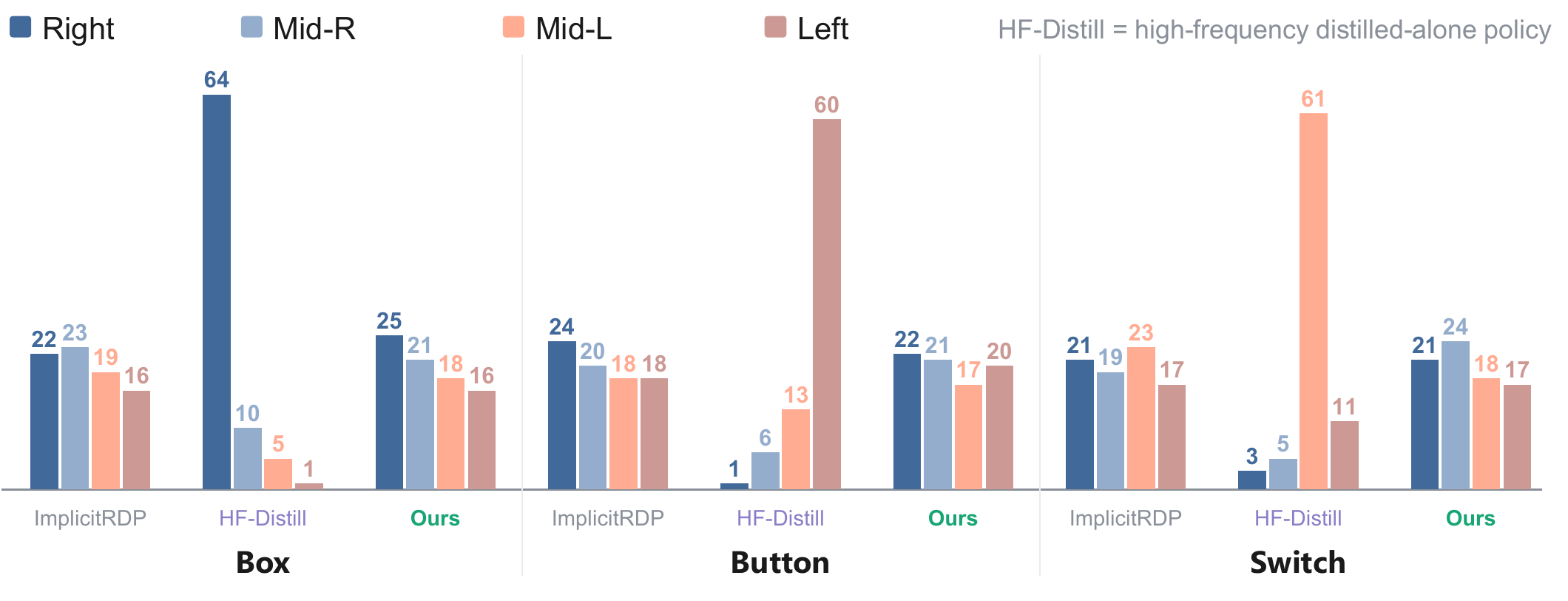
Counting pre-contact trajectories across the four approach modes, FA-RDP covers all four while the high-frequency-only policy collapses to one. Low-frequency sampling before contact preserves the multimodality of multi-step diffusion.

Multimodal Preservation

FA-RDP covers all four approach modes; the high-frequency-only policy collapses to one.

The four valid approach trajectories FA-RDP recovers before contact on Box Flipping:

Left
Middle-Left
Middle-Right
Right

Q3 · Indicator Accuracy & Force Curves

Does the indicator switch at the right moment?

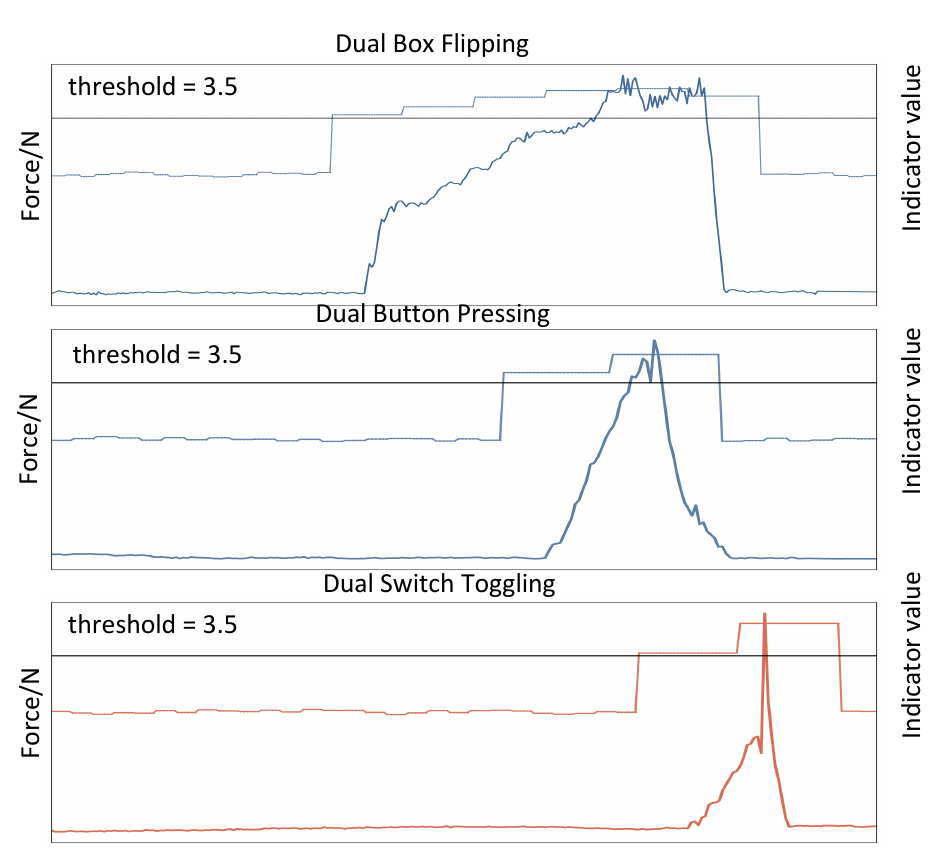
The indicator stays low before contact, so FA-RDP keeps the low-frequency sampler for a smooth approach, and rises with the force response after contact, so it switches to the high-frequency sampler for reactive execution. This learned switching raises the average success rate from 61.7% to 81.7% over always running high frequency.

Confidence and Force Curves

The indicator stays low before contact and rises after contact, triggering the switch from low- to high-frequency sampling. Switching lifts average success from 61.7% to 81.7%.

Frequency Selection Box Flipping Switch Toggling Button Pressing Avg.
Always high-frequency (no switching) 12/2011/2014/2061.7%
Indicator-guided switching (Ours) 14/2017/2018/2081.7%

Indicator-guided switching improves every task and raises average success by 20 points over always running high frequency.

Q4 · Distillation Method Comparison

Does MCD beat other one-step distillation methods?

With selection off and all methods running high frequency, one-step sampling without distillation is inaccurate, and MeanFlow and Consistency nearly collapse to 1.7% because they must fit noise-like targets. MCD predicts on the action manifold and reaches 61.7%, over 3× the next best.

Method Box Flipping Button Pressing Switch Toggling Avg.
High-frequency alone policy 4/203/205/2020.0%
MeanFlow Policy 0/200/201/201.7%
Consistency Policy 0/200/201/201.7%
High-frequency distilled alone policy (MCD) 12/2014/2011/2061.7%

One-step sampling without distillation drops accuracy, and MeanFlow / Consistency nearly collapse (1.7%). MCD reaches 61.7%.

MCD (Ours) ✓
High-Freq Alone ✗
MeanFlow ✗
Consistency ✗

Only MCD produces smooth one-step actions that flip the box; the others stall or diverge.

MCD (Ours) ✓
High-Freq Alone ✗
MeanFlow ✗
Consistency ✗

Only MCD produces smooth one-step actions that toggle the switch; the others stall or diverge.

MCD (Ours) ✓
High-Freq Alone ✗
MeanFlow ✗
Consistency ✗

Only MCD produces smooth one-step actions that press the button; the others stall or diverge.